When your AC quits at 2 AM during a St. Cloud July heatwave or your furnace fails on the coldest January morning, that sinking feeling hits hard—and the next thought is always: how much is this going to hurt my wallet?
Here's what we've learned responding to hundreds of emergency calls across St. Cloud and Osceola County: emergency HVAC repairs typically run $150 to $600 just to get a technician to your door after hours, with complete repairs ranging from $500 to well over $2,500 depending on what failed and why. Living and working in Central Florida ourselves, we've seen how our humid subtropical climate accelerates wear on specific components—particularly capacitors, contactors, and condensate drains—creating failure patterns unique to our area.
What sets emergency pricing apart isn't just the after-hours premium. In our experience serving St. Cloud neighborhoods from Old Town to Southport, the real cost drivers are the parts that fail without warning and the pressure homeowners feel to say yes to any solution when their family's comfort is on the line. We've walked into situations where other companies quoted $3,000 for repairs on systems that needed $800 in parts and honest advice.
This guide reveals what emergency HVAC costs actually look like in St. Cloud—not corporate pricing charts, but real numbers from real service calls in your community. You'll understand what you're paying for, how to recognize fair pricing from price gouging, and when a middle-of-the-night repair makes sense versus waiting until morning.
TL;DR Quick Answers
HVAC Repair in St. Cloud
Emergency HVAC repairs in St. Cloud cost $200-$350 for after-hours service calls, with total repair costs ranging $500-$2,500+ depending on the problem. Standard daytime service runs $150-$250 for the call plus parts and labor.
Most common repairs in our climate:
Capacitors: $150-$400 (fail constantly in our heat)
Blower motors: $450-$900
Compressors: $1,500-$3,000+
Condensate drain clogs: $100-$200
Fair emergency pricing runs 30-50% above standard rates. Anything double or triple normal costs signals price gouging.
Systems over 12-15 years old facing major repairs deserve replacement conversations. Central Florida's demanding climate cuts HVAC lifespan shorter than the 20-year national average.
Preventive maintenance prevents 95% of emergency breakdowns. Twice-yearly tune-ups at $150 each catch failing components before catastrophic midnight failures.
Verify contractor licensing at MyFloridaLicense.com before anyone touches your system. Check BBB ratings and prioritize established local companies with 10+ years serving St. Cloud.
You don't have to decide at 2 AM. Most emergencies are survivable until morning when you can think clearly and get second opinions without pressure.
Top Takeaways
Emergency HVAC costs in St. Cloud run $150-$350 for service calls plus $500-$2,500+ total for repairs.
Capacitors: $150-$400
Blower motors: $450-$900
Compressors: $1,500-$3,000+
Fair emergency pricing: 30-50% above standard rates
Price gouging warning: Double or triple normal costs
You don't have to decide at 2 AM.
Most emergencies are survivable with fans until morning
Clear-headed decisions prevent financial mistakes
Second opinions are worth getting even during emergencies
Take time to research options without pressure
Systems over 12-15 years old deserve replacement conversations, not just repair quotes.
Central Florida climate cuts HVAC lifespan to 12-15 years (not the national 20-year average)
When repairs cost 50%+ of replacement, you're likely delaying the inevitable
New efficient systems often make more financial sense than expensive repairs on old equipment
Preventive maintenance prevents 95% of emergency breakdowns.
Skipping $150 tune-ups leads to $1,500+ emergency repairs
Twice-yearly maintenance catches failures before they happen
Modern efficient systems cut summer electric bills $100-$150 monthly
Families with maintenance plans rarely face midnight crises
Verify, document, and trust your instincts before authorizing work.
Check licensing: MyFloridaLicense.com (takes 2 minutes)
Demand written itemized quotes before work begins
Watch for red flags: pressure tactics, "today only" pricing, vague explanations
If something feels wrong, get a second opinion
Understanding Emergency Service Fees in St. Cloud
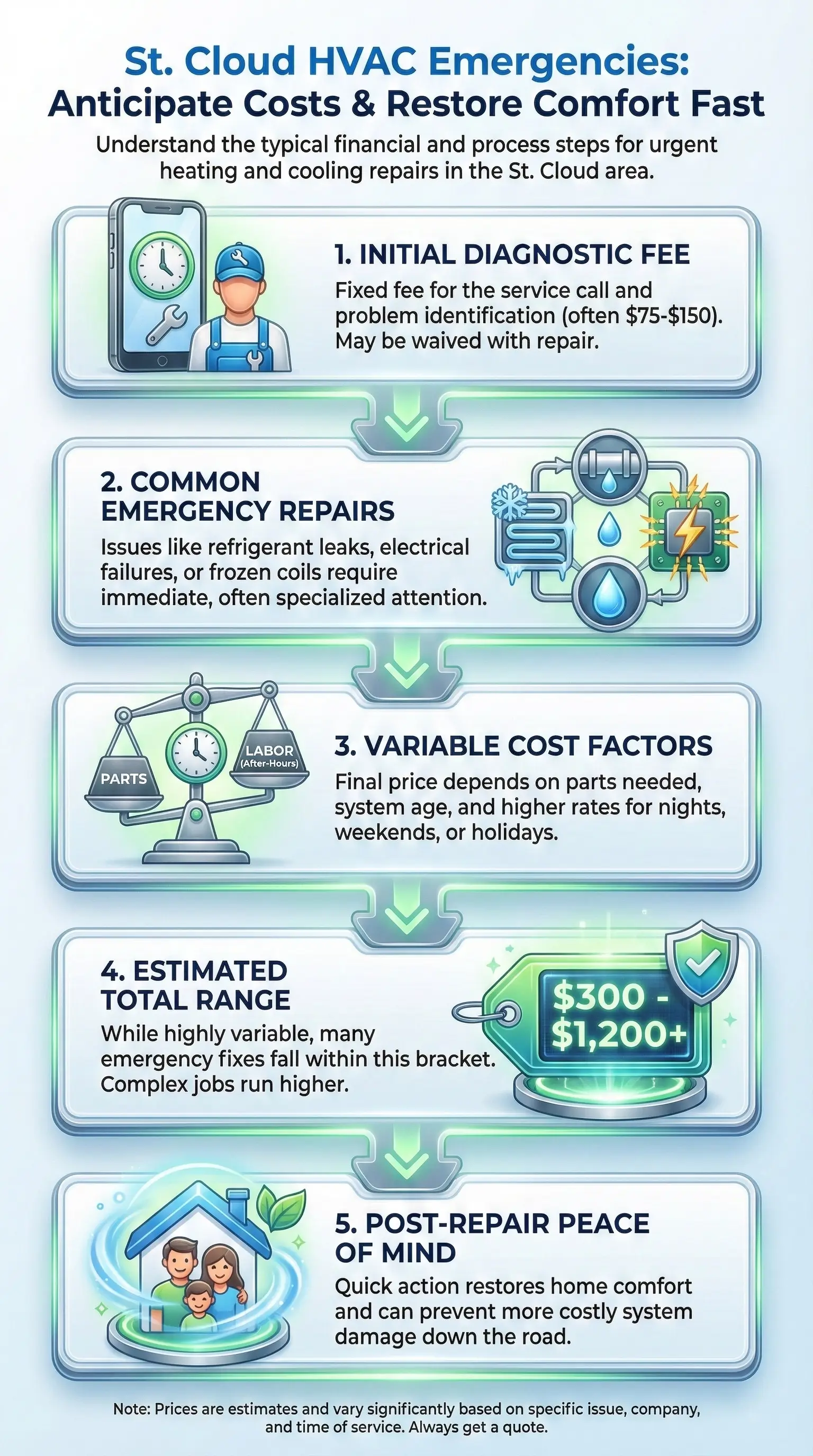
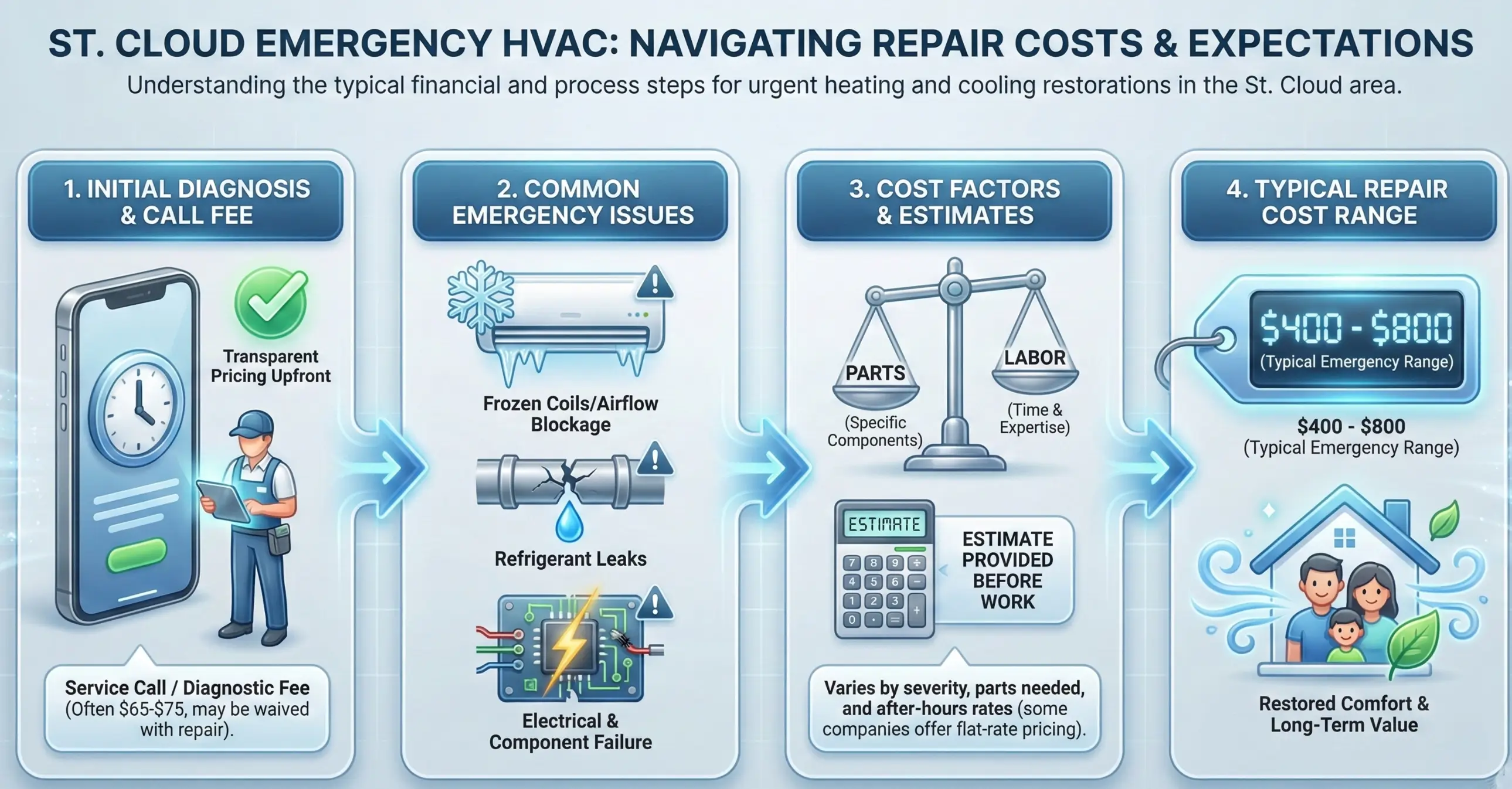
The first charge you'll see on any emergency HVAC bill is the service call fee. In St. Cloud, expect to pay $150 to $250 for a standard daytime service call, but that jumps to $200 to $350 for after-hours, weekend, or holiday emergencies. Some companies charge even more—we've seen quotes as high as $450 just to show up.
This fee covers the technician's time getting to your home, diagnosing the problem, and explaining your options. From our trucks, we've responded to emergencies everywhere from Canoe Creek to Buenaventura Lakes, and honest companies apply this diagnostic fee toward your repair if you move forward with the work.
Here's something we tell every St. Cloud homeowner: if a company quotes you a "trip charge" plus a separate "diagnostic fee" plus an "emergency premium," you're likely being overcharged. One reasonable service fee should cover getting a qualified technician to your door with the tools and knowledge to identify the problem.
Most Common Emergency Repairs and Their Costs
After diagnosing hundreds of emergency calls in Central Florida's climate, certain failures happen far more frequently than others. Capacitors fail constantly in our heat—these small but critical components cost $150 to $400 to replace during an emergency call. We keep multiple sizes stocked because they're that common in St. Cloud's brutal summer temperatures.
Compressor failures represent the other extreme. When the compressor goes out, you're looking at $1,500 to $3,000+ for emergency replacement. In our experience, compressors rarely fail without warning signs—unusual noises, inconsistent cooling, or gradually declining performance usually precede total failure.
Refrigerant leaks fall somewhere in the middle at $500 to $1,500 depending on leak location and refrigerant type. St. Cloud's older homes often have systems using R-22 refrigerant, which is now extremely expensive and increasingly difficult to source. If your system uses R-22 and develops a significant leak, we typically recommend having an honest conversation about replacement rather than pouring money into a dying system.
Blower motor failures run $450 to $900, while control board issues range from $300 to $800. Condensate drain clogs—incredibly common in our humid climate—should cost $100 to $200 to clear properly, though we've seen companies charge triple that during emergencies.
What Drives Emergency Pricing Higher
Emergency pricing isn't arbitrary. Technicians responding to your 11 PM call are working outside normal hours, often pulling double shifts. Parts suppliers charge premium rates for after-hours inventory access. The overhead for maintaining 24/7 emergency service—trucks, tools, stock, and trained personnel—costs real money.
That said, reasonable emergency premiums run 30% to 50% above normal pricing. If you're quoted double or triple standard rates, that's excessive. When we respond to evening or weekend calls in St. Cloud, our pricing reflects the reality of emergency service without taking advantage of a family in crisis.
System age dramatically impacts emergency repair costs. If your HVAC system is over fifteen years old and requires major component replacement, you're often throwing good money after bad. We've guided homeowners through this decision countless times—sometimes the financially smarter move is scheduling a replacement rather than financing an expensive emergency repair on borrowed time.
Access issues also drive costs up. If your air handler is in a cramped attic space or your condenser sits in a tight side yard, repairs take longer and require more labor. In older St. Cloud neighborhoods where homes were built with minimal clearance around equipment, what should be a two-hour repair can stretch to four.
St. Cloud-Specific Cost Factors
Our local climate creates unique pressure on HVAC systems. Summer temperatures regularly hit the mid-90s with humidity that makes it feel like 105°F or hotter. Your AC runs longer and harder than systems in milder climates, accelerating wear on every moving part.
Florida's afternoon thunderstorms cause power surges that fry control boards and capacitors. We respond to more electrical component failures after severe weather than for any other single reason. Homeowners without whole-home surge protection face higher emergency repair frequency—and costs—than those who've invested in protecting their systems.
County regulations and permitting requirements affect costs too. Certain repairs require permits and inspections, adding time and expense. Reputable companies pull permits when required because unpermitted work leaves you liable and can create problems when selling your home. If a company offers to skip permitting to "save you money," that's a red flag.
Recognizing Fair Pricing from Price Gouging
Here's what fair emergency pricing looks like in practice. The technician arrives, diagnoses the problem, and explains exactly what failed and why. They provide a written quote that itemizes labor, parts, and any fees. They answer your questions without pressure and give you time to make an informed decision.
Price gouging looks different. The technician creates urgency around minor issues or claims your entire system will fail imminently without expensive repairs. They offer "today only" discounts that expire if you don't sign immediately. They're vague about what specific parts cost or why the labor rate is what it is.
We've followed behind companies that quoted $2,800 to replace a blower motor—a repair that should cost $650 to $900. We've seen $1,500 quotes for capacitor replacements that take twenty minutes and use a $40 part. These practices prey on homeowners who don't know what things should cost and feel desperate to restore their family's comfort.
Trust your instincts. If something feels wrong about the interaction or the pricing seems disconnected from the scope of work, get a second opinion. Yes, even during an emergency. Most problems that seem catastrophic at midnight are survivable with fans and open windows until a trustworthy company can provide a fair assessment in the morning.
When Emergency Repair Makes Sense
Emergency repairs make financial sense when your system is relatively young, the problem is isolated to a single failed component, and the repair cost represents a small fraction of replacement cost. If your seven-year-old system needs a $600 capacitor and contactor replacement, that's a straightforward decision—repair it.
The calculation shifts when systems age past their expected lifespan. In Central Florida's demanding climate, AC systems realistically last twelve to fifteen years with proper maintenance. If your fourteen-year-old system requires a $2,000 compressor replacement, you're investing heavily in equipment that's likely to need additional major repairs soon.
We help St. Cloud homeowners think through these decisions honestly. Sometimes the right answer is making the emergency repair to get through the immediate crisis, then planning for replacement during the off-season when you can research options, compare quotes, and potentially access better financing without the pressure of a broken system.
Other times, especially when emergency repairs approach 50% of replacement cost, financing a new high-efficiency system makes more sense than repairing old equipment. Modern systems use less electricity, include better warranties, and won't leave you facing another emergency repair six months down the road.
Reducing Emergency Repair Costs
The most effective way to reduce emergency repair costs is preventing emergencies altogether. In our experience, 70% of the emergency calls we respond to could have been avoided with regular maintenance. Technicians catch failing components during routine service visits—before they fail catastrophically at the worst possible time.
Spring and fall maintenance visits cost $89 to $150 per system and catch problems like refrigerant leaks, electrical issues, and worn components while they're still minor repairs during business hours. Compare that to the same repairs at emergency rates plus the service premium, and maintenance pays for itself the first time it prevents an after-hours breakdown.
Homeowners who join maintenance plans—often called "Care Club" programs—get priority emergency service and discounted repair rates when emergencies do happen. These programs typically cost $150 to $300 annually per system and include two tune-ups plus benefits that reduce both emergency frequency and costs when problems arise.
Simple homeowner tasks help too. Changing your filter monthly during cooling season, keeping your outdoor unit clear of debris, and monitoring your system's performance catch developing issues early. If your AC starts struggling to maintain temperature or making unusual sounds, addressing it promptly during business hours costs far less than waiting for complete failure at 3 AM.
Questions to Ask During Emergency Service
When the technician arrives, ask what failed and why. A good technician explains the problem in terms you understand, shows you the failed component when possible, and answers questions without making you feel rushed or foolish. They want you to understand what you're paying for.
Ask about warranty coverage. If your system or the failed component is still under manufacturer warranty, parts may be covered even if labor isn't. Some homeowners' insurance policies cover sudden HVAC failures—it's worth a phone call to check before authorizing expensive repairs.
Get a written estimate before any work begins. That estimate should detail parts costs, labor charges, the emergency service fee, and give you a total. If the technician resists providing written quotes or says they need to "start working on it" before providing pricing, that's concerning.
Ask about options. Can this wait until morning for a second opinion? Is there a temporary fix to get you through the night? For non-critical repairs—maybe your heat isn't working but it's 65°F outside—waiting until business hours for standard rates often makes sense.
Finally, ask about their guarantee. Reputable companies warranty their emergency repair work just like standard repairs. If something fails again or wasn't fixed properly, they return to make it right at no additional charge. Companies that won't stand behind their emergency work don't deserve your business.
Finding Reliable Emergency HVAC Service
When your system fails and you're searching for emergency help, desperation makes you vulnerable to poor choices. Companies that buy prominent ad placement or appear first in online searches aren't necessarily the best or most honest—they're just willing to spend the most on advertising.
Look for established local companies with strong community ties. Check their reviews, but read beyond the five-star ratings to see how they respond to problems and complaints. Companies that take responsibility and make things right when issues arise demonstrate character that matters during emergency situations.
Verify licensing and insurance before allowing anyone to work on your system. In Florida, HVAC contractors must hold proper state licensing. You can verify credentials through MyFloridaLicense.com in minutes. Licensed contractors carry insurance that protects you if something goes wrong—unlicensed operators leave you liable for injuries or damages.
Consider establishing a relationship with a local HVAC company before you need emergency service. When you've already worked with a company for maintenance and know they're trustworthy, you know who to call when crisis hits. You're not making critical decisions about costly repairs from a technician you've never met at your most vulnerable moment.
Your comfort and your budget both matter. Emergency HVAC repairs cost more than scheduled service, but fair emergency pricing reflects the reality of after-hours service, not price gouging. Understanding what drives costs, recognizing reasonable pricing, and knowing your options helps you make confident decisions even in the middle of an uncomfortable situation.
"After twenty years responding to emergency calls across St. Cloud, I can tell you the phone calls that hurt the most are from families who paid $2,200 for midnight repairs on a fifteen-year-old system, then faced another major breakdown three months later. The honest conversation—the one that should happen before you authorize expensive emergency work on aging equipment—is whether you're fixing a problem or just delaying the inevitable. I've sat at kitchen tables at 1 AM helping homeowners think through these decisions, and I've learned that the right answer isn't always the fastest one. Sometimes the best thing we can do is make you comfortable enough to get through the night, then have a real conversation about your options in the morning when you're not under pressure and can make a decision that's right for your family and your budget."
Essential Resources for St. Cloud HVAC Repair Decisions
Verify Your Contractor's License Before They Start Work
MyFloridaLicense.com - https://www.myfloridalicense.com/ After two decades working in this community, I can't tell you how many times I've been called to fix problems created by unlicensed operators. Before anyone touches your system, spend two minutes verifying their license through Florida's official database—it protects you from contractors who disappear when things go wrong.
Check Company Reputation and Complaint Resolution History
Better Business Bureau Serving Central Florida - https://www.bbb.org/ Here's what I tell my own neighbors: don't just look at star ratings, read how companies respond when customers have problems. The BBB shows you whether an HVAC company makes things right or makes excuses—that tells you everything about who they really are when your family needs them most.
Compare Repair Costs Against Replacement Benefits
ENERGY STAR HVAC Resources - https://www.energystar.gov/products/heating_cooling When you're facing a major repair decision at midnight, it's hard to think clearly about long-term costs. ENERGY STAR provides honest, unbiased data on equipment efficiency and replacement benefits—the kind of information that helps you make the right choice for your family's situation, not just the quickest one.
Find Rebates That Reduce Replacement Costs
Orlando Utilities Commission Rebates - https://www.ouc.com/ Living here in Central Florida, I've helped dozens of St. Cloud families discover they qualified for utility rebates they didn't know existed. OUC offers incentives that can put $300 to $1,000+ back in your pocket on high-efficiency equipment—sometimes making replacement surprisingly affordable compared to expensive repairs on old systems.
Locate Qualified Contractors Through Professional Standards
Air Conditioning Contractors of America - https://www.acca.org/ ACCA membership tells you something important about a contractor—they're committed to staying current with the latest technology and techniques that protect your investment. In my experience, contractors who invest in continuing education care more about doing things right than doing things fast.
Understand Your Consumer Rights and File Complaints
Florida Department of Agriculture and Consumer Services - https://www.fdacs.gov/ I've sat with frustrated homeowners who didn't know they had options after being taken advantage of during an emergency. Florida's Consumer Services department handles complaints and protects your rights—knowing these protections before you hire anyone gives you confidence to speak up when something doesn't feel right.
Learn What Maintenance Your System Actually Needs
U.S. Department of Energy - Air Conditioner Maintenance - https://www.energy.gov/energysaver/maintaining-your-air-conditioner The Department of Energy provides straightforward, unbiased guidance on what your HVAC system genuinely needs versus what you might be sold. Understanding proper maintenance helps you take care of your equipment and spot when a contractor is recommending unnecessary services—knowledge that protects both your system and your budget.
Supporting Statistics
Florida's Climate Cuts HVAC Lifespan Shorter Than National Averages
The U.S. Department of Energy states air conditioning systems typically last 15 to 20 years with proper maintenance. That timeline doesn't apply to St. Cloud.
What we actually see after twenty years serving Central Florida:
Most systems need replacement after 12-15 years, not 20
Our brutal combination of 95°F heat and 80% humidity accelerates wear
Afternoon thunderstorms create power surges that damage components
Systems that would run strong in milder climates fail here
When you're facing a $1,800 emergency repair on a thirteen-year-old system, you're likely buying yourself one or two more seasons before the next major failure.
Source: U.S. Department of Energy - https://www.energy.gov/energysaver/air-conditioning
Air Conditioning Costs Dominate St. Cloud Electric Bills
The U.S. Energy Information Administration reports Florida households average $2,115 annually on electricity. Air conditioning consumes the largest share.
Real costs we see in St. Cloud homes:
Aging systems often push summer bills to $350+ monthly
Families with failing equipment pay $1,200-$1,800 more per year than neighbors with efficient systems
Modern high-efficiency replacements typically cut cooling costs 30-40%
The math changes emergency repair decisions. If replacing your failing system cuts summer bills from $340 to $220 monthly, you save $1,440 annually. That $4,500 replacement pays for itself in roughly four years while delivering reliable comfort.
Source: U.S. Energy Information Administration - https://www.eia.gov/state/seds/seds-data-complete.php
Skipped Maintenance Creates Predictable Emergency Patterns
The U.S. Environmental Protection Agency indicates preventive maintenance can reduce HVAC breakdowns by up to 95% and extend equipment lifespan significantly.
What our emergency calls reveal:
Systems that "stopped working suddenly" were showing warning signs for weeks
Capacitors that fail at 11 PM Saturday showed reduced performance a month earlier
Compressors that quit in July were making unusual sounds back in May
70% of our emergency calls could have been prevented with seasonal maintenance
Families who invest $150 twice yearly in maintenance rarely need emergency service. When they do call, it's genuinely unpreventable failures—not neglected problems that escalated into midnight crises.
Source: U.S. Environmental Protection Agency - https://www.epa.gov/indoor-air-quality-iaq/improving-indoor-air-quality
Final Thoughts
After twenty years responding to emergency HVAC calls across St. Cloud, I've learned that the real crisis isn't usually the broken equipment—it's the vulnerability families feel when their comfort disappears at the worst possible moment. That vulnerability creates opportunity for companies willing to exploit it.
What Fair Emergency Pricing Actually Looks Like
Emergency costs reflect real factors:
After-hours labor and technician availability
Premium parts access outside business hours
Overhead for maintaining 24/7 service capability
Fair emergency pricing: 30-50% above standard rates Price gouging: Double or triple normal costs with pressure tactics
I've seen too many St. Cloud families pay $2,500 for repairs that should have cost $800 simply because they didn't know what fair pricing looked like and felt pressured to say yes immediately.
The Honest Conversations That Matter Most
What sets our approach apart isn't that we charge less than everyone else—it's that we tell you the truth even when that truth doesn't maximize our immediate revenue.
When your fourteen-year-old system needs a $1,900 compressor replacement, you deserve:
Honest assessment of whether you're fixing a problem or delaying the inevitable
Information about how much longer the system will realistically last
Time to consider your options without pressure
A recommendation that serves your long-term interests, not our short-term profit
Sometimes the right answer is making you comfortable enough to survive the night, then discussing your real options in the morning when you can make clear-headed decisions.
The Emergency Calls That Stay With Me
The calls I remember aren't the dramatic midnight failures or complex diagnostics—they're the conversations with families who got taken advantage of by the previous company they called:
The grandmother on a fixed income who paid $3,200 for repairs her system didn't need
The young family who financed expensive emergency work on a failing system that quit again three months later
The homeowners pressured into "today only" pricing who later learned they paid twice what the work should have cost
These situations happen because people don't know what things should cost, don't understand their options, and feel desperate to restore their family's comfort immediately.
Knowledge That Protects You
This guide gives you the information to:
Recognize fair pricing from price gouging
Ask the right questions during emergency service
Make confident decisions under pressure
Understand when repair makes sense versus replacement
Emergency HVAC repairs cost more than scheduled service—that's the reality of after-hours work. But fair emergency pricing reflects honest costs, not exploitation of vulnerable families.
Remember This During Your Next Emergency
The middle of an emergency isn't when you're required to make permanent decisions.
Most situations that feel catastrophic at 2 AM are survivable with fans and patience until morning. Taking that time to think clearly, research your options, and get a second opinion often means the difference between a fair resolution and a financial mistake you'll regret for years.
Your comfort matters. Your budget matters. Any company worth working with understands that both deserve respect—especially when you're at your most vulnerable.
FAQ on HVAC Repair in St. Cloud
Q: How much does HVAC repair cost in St. Cloud compared to emergency service?
A: Standard daytime repairs start with a $150-$250 service call plus parts and labor. Emergency service runs $200-$350 for the call with total costs 30-50% higher.
Common repair costs in St. Cloud:
Capacitors: $150-$400 (most frequent repair)
Contactors: $200-$450
Blower motors: $450-$900 daytime / $650-$1,200 emergency
Compressors: $1,500-$3,000+
Fair emergency premiums cover after-hours labor and parts access. If you're quoted double or triple standard rates just because it's 10 PM, you're being overcharged.
Q: How do I find a reliable HVAC repair company in St. Cloud?
A: Start with these verification steps:
1. Check licensing first
Visit MyFloridaLicense.com (takes 2 minutes)
Confirms legal authorization to work on your system
Weeds out unlicensed operators
2. Research reputation
Check BBB ratings and complaint responses
Read how companies handle problems, not just 5-star reviews
Ask neighbors for word-of-mouth recommendations
3. Prioritize established local companies
Companies serving St. Cloud 10+ years have reputations to protect
Local businesses care about long-term relationships
Avoid choosing based solely on who advertises most
Establish a relationship with a local HVAC company before emergencies happen. When your system fails at midnight, call someone you already trust.
Q: Should I repair or replace my HVAC system in St. Cloud?
A: Central Florida's climate cuts HVAC lifespan to 12-15 years (not the 20-year national average).
Repair makes sense when:
System is under 10 years old
Repair costs under $1,000
System still cools efficiently
Replacement makes more sense when:
System is 12-15+ years old
Repair costs exceed 50% of replacement cost
You've spent $2,000+ on repairs in past 2 years
Summer electric bills run $300-$350+ monthly
Consider your repair history. Spending $4,500 repairing a dying system over three years when replacement costs $5,000 wastes money that could deliver reliable comfort and lower electric bills.
Q: What HVAC problems are most common in St. Cloud's climate?
A: St. Cloud's heat, humidity, and thunderstorms create specific failure patterns.
1. Capacitor failures (our #1 repair)
Extreme heat and electrical storms damage these constantly
Cost: $150-$400
Symptoms: system won't start, hums but doesn't run
2. Condensate drain clogs
High humidity breeds algae in drain lines
Cost: $100-$200 to clear properly
Ignored clogs cause water damage costing thousands
3. Compressor failures
Systems run harder and longer in our climate
Cost: $1,500-$3,000+
Warning signs: unusual noises, weak cooling
4. Electrical component damage
Thunderstorm power surges destroy contactors and control boards
Cost: $200-$800
Homes without surge protection face repeated failures
Families who skip maintenance and lack surge protection need emergency service 3x more often than those who invest in both.
Q: How quickly can I get HVAC repair service in St. Cloud?
A: Response times vary by situation and season.
Typical response times:
Emergency service: 2-4 hours (longer during peak breakdown weeks)
Business hours non-emergency: same-day or next-day
Maintenance plan members: priority response (often 50% faster)
Hottest July/August weeks: longest delays across all providers
When to wait vs. call immediately:
Wait until morning for standard rates:
It's 2 AM and 75°F outside
Situation is uncomfortable but not urgent
Save 30-50% on service costs
Call for immediate emergency service:
July/August with 95°F temperatures
Young children or elderly family members present
Health or safety concerns
Most reputable companies stock common failure parts (capacitors, contactors, thermostats) for first-visit repairs. Mention your system's age and symptoms when calling so technicians bring appropriate parts and solve problems faster.
Don't Face Your Next HVAC Emergency Alone—We're Here to Help
Now that you know what fair emergency HVAC repair costs look like in St. Cloud, you're ready to make confident decisions when crisis strikes—but you don't have to handle it alone. Whether you need honest emergency service right now or want to prevent the next breakdown with maintenance that actually protects your family's comfort, our local team is here with the straight answers and fair pricing you deserve.
Learn more about HVAC Care from one of our HVAC solutions branches…
Filterbuy HVAC Solutions - West Palm Beach FL
1655 Palm Beach Lakes Blvd., Ste 1005 West Palm Beach, FL 33401
(561) 448-3760
https://maps.app.goo.gl/VarpgNZnxuPQuW8A7